
Most people assume recovery from catastrophic injury means learning to live with permanent pain. Rex Burruss was told exactly that until an unexpected therapy changed everything.
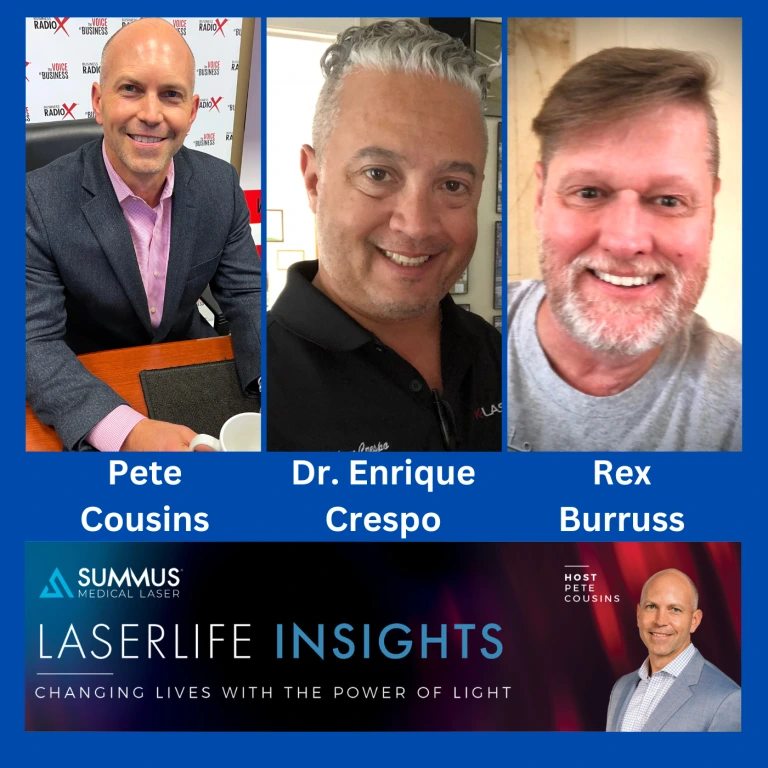
In this episode of LaserLife Insights, host Pete Cousins sat down with Dr. Enrique Crespo, a seasoned chiropractor and integrative medicine practitioner, and Rex Burruss, a designer and amputee whose story redefines what it means to heal.
Their conversation wasn't just about technology. It was about faith, perseverance, and the incredible adaptability of the human body. Here's what we learned about resilience, recovery, and the science of light.
Some people find their profession; others are born into it.
"I knew for a fact at six years old that I wanted to be a doctor," Dr. Crespo recalled. "I asked my mom for a skeleton model, not a toy."
A childhood fascination with anatomy evolved into a lifelong mission to help others move, live, and feel better. After experiencing firsthand how chiropractic care transformed his recovery from a serious car accident, he knew he'd found his calling.
"I tell my kids I haven't worked a single day since 1998 because I love what I do."
That passion hasn't wavered in over 25 years of practice.
From the beginning, Dr. Crespo's practice blended medical rigor with heart-centered purpose. He built his career on one guiding principle: every patient deserves to heal fully - body, mind, and spirit.
When the pandemic hit, he didn't shut down. Instead, he reimagined how care could look. Patients waited in their cars; the parking lot became an outdoor waiting room; safety protocols protected everyone without compromising care.
"It was out of necessity," he said. "But it made us better. We became more patient-focused than ever."
That adaptability, that refusal to let obstacles stop healing, would become crucial to Rex's story.
Chiropractic adjustments may have been his foundation, but innovation became his future.
In 2020, Dr. Crespo integrated regenerative medicine into his practice, combining chiropractic, physical therapy, nutrition, and medical expertise under one roof.
"Regenerative medicine is one umbrella," he explained. "Functional medicine, chiropractic, physical therapy, and nutrition, all working in unison for the better cause of the patient."
His care model emphasizes collaboration with MDs, anesthesiologists, and nurse practitioners to deliver comprehensive healing, not just symptom management. It’s an approach grounded in non-opioid pain management, focusing on natural recovery rather than masking pain with medication.
This integrative philosophy would prove essential when Rex walked through his door.
Long before "photobiomodulation" became a healthcare buzzword, Dr. Crespo was experimenting with class IV laser therapy.
These medical-grade lasers don't cut or burn. They deliver precise infrared light energy deep into tissue to reduce inflammation, ease pain, and promote cellular regeneration.
"The laser's primary emphasis is to mitigate pain, but it also helps to upregulate tissue regeneration," he explained.
By pairing laser therapy with other modalities - regenerative injections, targeted physical therapy, nutritional support,he's helping patients recover faster and more naturally, often avoiding the need for long-term medication or invasive surgery.
The technology works on a cellular level, energizing mitochondria and helping the body do what it's designed to do: heal itself.
And that's where Rex Burruss enters the story.
A talented graphic designer and former dancer, Rex's life changed forever in 2016 when he suffered a catastrophic heart rupture that led to multiple amputations. He woke from a weeks-long coma missing his left leg below the knee, parts of his right foot, and two fingers.
But the hardest part wasn't what he lost. It was the unrelenting pain that followed.
"They told me I'd have to live with pain forever," he said. "The medications didn't work. They dulled my mind but not the pain."
He lived with severe phantom limb pain: the brain's way of feeling sensations in limbs that no longer exist. For more than a year, the agony was unbearable. Sleep became impossible. Daily life felt like an endurance test.
Then he met Dr. Crespo.
"That afternoon, I found relief," Rex said simply. "It was miraculous."
Phantom limb pain affects up to 90% of amputees, and its origin lies in the brain's remarkable and sometimes problematic design.
"The brain still sees the missing limb because the nerve system's roots remain shaped like the original body," Dr. Crespo explained.
He illustrated it with a vivid metaphor: "It's like a plant outgrowing its pot. The roots take the shape of the container even after you remove it. The nervous system remembers your body the same way."
Even though Rex's leg was gone, his nervous system continued sending signals as if it were still there, signals interpreted as pain, cramping, or burning sensations.
Laser therapy, Dr. Crespo believes, helps "reset" those misfiring neural signals, allowing the brain and body to find peace again. By delivering targeted light energy to the affected nerve pathways, the treatment can interrupt the pain cycle and promote healthier nerve function.
For Rex, the relief was immediate and profound. The therapy became a cornerstone of his phantom limb pain relief journey.
Today, Rex is far more than a survivor. He's an advocate and mentor.
Through the Amputee Coalition and the Amputee Foundation of Greater Atlanta, he supports others living with limb loss, offering guidance, encouragement, and lived experience.
"There are 4.6 million Americans living with limb loss or limb difference," he noted. "And we're a strong community."
The foundation hosts local meetups, hybrid support sessions, and even adaptive rock climbing events for people with prosthetics. Their annual national conference brings together thousands of amputees to connect, learn, share resources, and simply be understood.
"For one weekend, you're not the only one," Rex said. "You're surrounded by people who understand."
That sense of community - combined with effective pain management - has allowed Rex not just to survive, but to thrive.
The story comes full circle in an unexpected and beautiful way: Rex now designs all of Dr. Crespo's advertising and marketing materials.
"I'm so excited about the services he offers and the success I've found, that I wanted to help share it with others," he explained.
Their partnership - one born from pain, forged through trust, and sustained by shared purpose - reflects the best of modern medicine: when science meets compassion, healing becomes a collaborative journey.
Rex's graphic design work now helps other patients discover the same hope and relief he found. What began as a desperate search for pain management has transformed into a mission to help others find their own path to healing.
Laser therapy isn't just a technology. It's a reminder of what becomes possible when innovation honors the human body's innate design, and when doctors and patients refuse to give up on each other.
Healing isn't always about erasing pain completely; sometimes, it's about rediscovering hope, reclaiming possibility, and finding new purpose.
Rex's journey proves that even after catastrophic loss, the human spirit - supported by compassionate care and innovative science - can not only endure but flourish. And sometimes, that hope arrives in the form of carefully calibrated light, penetrating tissue, resetting neural pathways, and illuminating a path forward that seemed impossible just moments before.