
Healing has a new language and it's made of light.
What started as an emerging tool for human recovery is now bridging worlds: veterinarians and physical therapists, pets and people, all benefiting from the same powerful innovation. The science doesn't discriminate by species; it simply works.
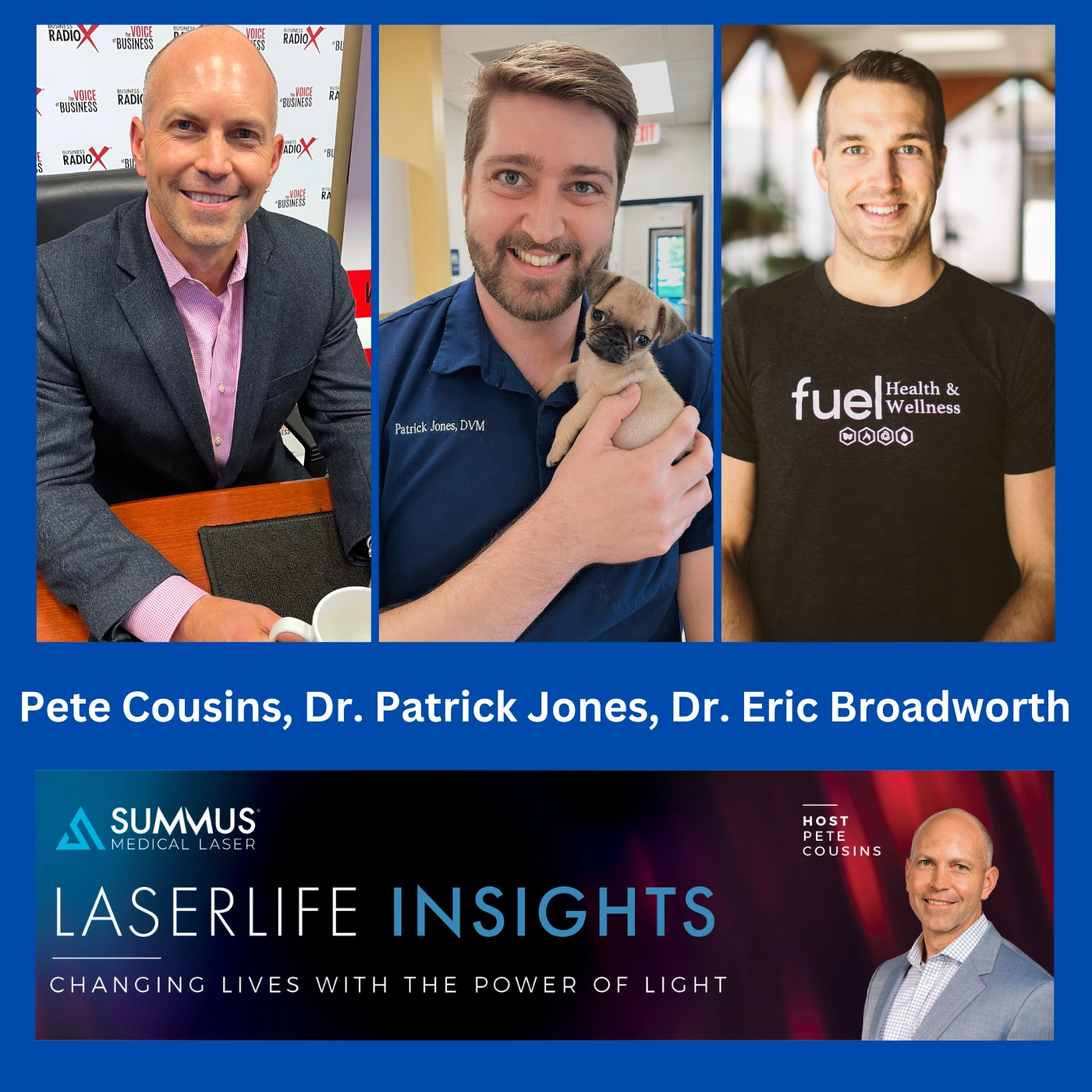
In this episode of LaserLife Insights, host Pete Cousins sat down with two healthcare professionals from entirely different disciplines: Dr. Patrick Jones, veterinarian and owner of Portside Veterinary Hospital in Charleston, South Carolina, and Dr. Eric Broadworth, physical therapist and founder of Fuel PT & Sports Performance in Grand Rapids, Michigan.
Together, they showed something important: laser therapy is changing how healing works for people and animals, proving that light helps cells heal in the same way for all living things.
Neither expert learned about laser therapy in formal training. Both discovered it the same way: through experimentation, professional curiosity, and results too compelling to ignore.
"We don't learn laser therapy in vet school," said Dr. Patrick Jones. "But once I saw how quickly it worked for wound healing and inflammation, I was hooked."
For Dr. Jones, the technology became indispensable almost immediately. From arthritic dogs struggling to climb stairs to post-surgical recovery and complex wound care, laser therapy accelerates healing and reduces pain without the side effects of pharmaceuticals.
One case stands out in his memory: a Cocker Spaniel named Oliver who had suffered chronic, painful ear infections for five years. Multiple medications had failed. Surgery seemed inevitable.
"After a few laser sessions, he was playing again, comfortable, and didn't need surgery. That's what makes it worth it."
Seeing an animal return to joy, to running, playing, living without constant discomfort never gets old.
Dr. Eric Broadworth witnesses the same transformative results in his physical therapy and sports performance clinic. Working with everyone from CrossFit competitors to weekend warriors recovering from injury, he now incorporates laser therapy with 90 to 100% of his patients.
"It speeds up healing so quickly," he explained. "One shoulder patient gained 30 degrees of motion after a single session."
For him, the laser's ability to reduce inflammation and stimulate deep tissue repair has become essential especially in treating neuropathy cases, where patients often experience up to 80% pain relief after just 16 sessions.
He’s also added full-body light therapy beds to his practice, extending care from specific injuries to overall wellness. These beds help clients address fatigue, poor sleep quality, skin health, metabolic function, and overall recovery capacity.
"Laser is for targeted healing, specific injuries, localized pain. The bed is for systemic benefits: full-body pain relief, energy restoration, recovery enhancement, and performance optimization."
The distinction matters. Targeted laser therapy addresses immediate clinical needs. Full-body phototherapy supports long-term wellness and resilience.
Whether treating a Labrador with hip dysplasia or an MMA fighter with a strained rotator cuff, both doctors operate from the same foundational belief - the body-human or animal - heals best when you support its natural regenerative systems instead of suppressing them.
"Anti-inflammatories shut off healing," Dr. Broadworth explained. "They mask symptoms but don't address the underlying tissue damage. Light therapy accelerates the actual healing process."
Dr. Jones sees the same principle playing out in his veterinary work. Medications can manage symptoms, but they often come with side effects especially for long-term use. Light therapy lets the body do what it's designed to do: repair itself.
"It's safe, non-invasive, and the results speak for themselves. Pet owners are amazed when their dogs start running again after weeks of pain and limited mobility."
Animals can't placebo themselves into feeling better. When a dog who could barely walk suddenly bounds across the yard, that's biological change, not wishful thinking.
For both clinics, laser therapy isn't just improving clinical outcomes, it's driving sustainable business growth.
Dr. Jones, who opened his clinic less than two years ago, reports an average of $1,500 in monthly revenue from laser treatments alone. That's enough to cover his equipment financing and generate meaningful profit, all while delivering better care.
Dr. Broadworth credits laser and light therapy for fueling his company's expansion:
"We've gone from two staff members to eight, and we're opening new locations. Financially, it's been huge; but more importantly, it gets patients better faster. That's what builds lasting practices."
The business case is straightforward: patients get better outcomes, practitioners can serve more people effectively, and clinics gain a competitive advantage. When you solve problems other providers can't, growth follows naturally.
Dr. Broadworth has since become a partner in Red Light Systems, a marketing and education firm helping other wellness clinics integrate and grow through light therapy services. He's teaching other practitioners what he learned firsthand: this technology works, and patients are actively seeking it out.
Despite working in different worlds - one focused on four-legged patients, the other on human athletes and chronic pain sufferers - their core motivation is identical: helping living beings move, function, and thrive without constant pain.
"When pet owners see their dog running again, really running, not limping or hesitating, it's amazing," said Dr. Jones. "That's why we do this."
"When a neuropathy patient who hasn't slept through the night in years finally gets uninterrupted rest, it's genuinely life-changing," added Dr. Broadworth. "Those moments remind you why you got into healthcare in the first place."
Laser therapy, they both believe, isn't just another treatment modality: it's transformation. It blends rigorous science with genuine compassion in a way that transcends species barriers and reminds us that healing principles are fundamentally universal.
Pain is pain. Inflammation is inflammation. Cellular regeneration follows the same biological pathways whether you're treating a German Shepherd or a marathon runner.
As more practitioners adopt light-based technology across disciplines, the artificial gap between human and veterinary care continues to narrow. Both fields are discovering that the same specific wavelengths of light can trigger recovery, reduce pain, and restore mobility naturally, safely, and remarkably quickly.
The evidence is mounting. The applications are expanding. The results are undeniable.
From pets regaining their playful spirit to athletes returning to competition ahead of schedule, from chronic pain sufferers finding relief after years of frustration to post-surgical patients recovering without complications, light therapy is proving its worth across every population it touches.
The technology respects no boundaries. It works on German Shepherds and grandmothers, Labrador Retrievers and CrossFit athletes, senior cats and professional fighters. The wavelengths don't care about species. They respond to cellular biology.
And as clinics like Dr. Jones's veterinary hospital and Dr. Broadworth's performance center demonstrate, this isn't experimental medicine anymore. It's proven, profitable, and becoming the standard of care for forward-thinking practitioners who prioritize outcomes over convention.
From pets to people, from startup practices to thriving multi-location clinics, the message is unmistakable: The future of healing isn't just bright, it's illuminated by science, powered by light, and limited only by our willingness to embrace what works.